Historically, audio processors are often described by frequency response, distortion, compression ratio, attack and release behavior, THD, and IMD.
Those descriptions are useful, but they do not fully explain perceived continuity effects that listeners often describe as glue, cohesion, groove, flow, or timing lock.
CALMAG investigates whether inter-event continuity can be measured directly through temporal, amplitude, and spectral redistribution rather than described only through conventional dynamics or saturation language.
The project is related to magnetic processing in the broad sense that operating state, calibration, level, and recovery behavior influence the result. However, CALMAG is not presented as a tape emulation. The measurements suggest a different balance of temporal behavior than typical tape-like coloration, with stronger emphasis on continuity between musical events.
Interpretive Framework
Temporal Redistribution Framework
This framework compares how different processor types tend to redistribute signal energy. It is proposed as an interpretive tool, not as a universal law.
The working hypothesis is that CALMAG is most clearly distinguished by its temporal redistribution behavior: the way energy persists, recovers, and connects events over time while preserving recognizable transient landmarks.
Research Observations
Reference Findings
#1 - State Persists Beyond Individual Events
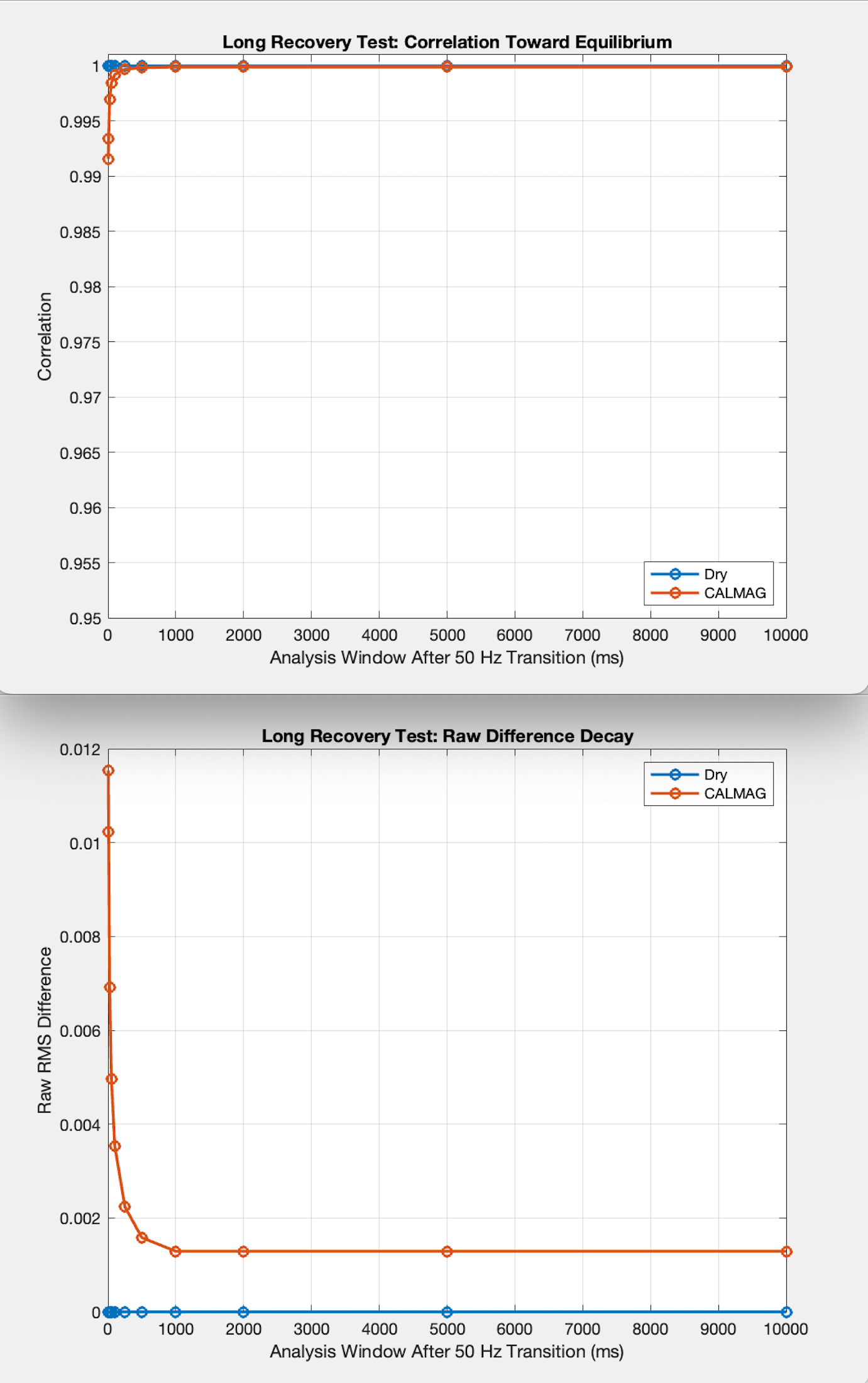
A mathematically generated test signal was used to compare the untreated path against CALMAG under identical conditions: 10 kHz tone → 50 Hz excitation → 10 kHz tone.
In the dry path, the second 10 kHz section returned to perfect measured identity with the first. Through CALMAG, the second 10 kHz section remained measurably different after the 50 Hz excitation.
The difference decayed rapidly over the first several hundred milliseconds, then stabilized slightly below perfect identity. This suggests fast state recovery followed by a subtly shifted operating condition rather than an immediate reset.
#2 - Continuity Emerges Between Objects
Temporal Consequence of Persistent State
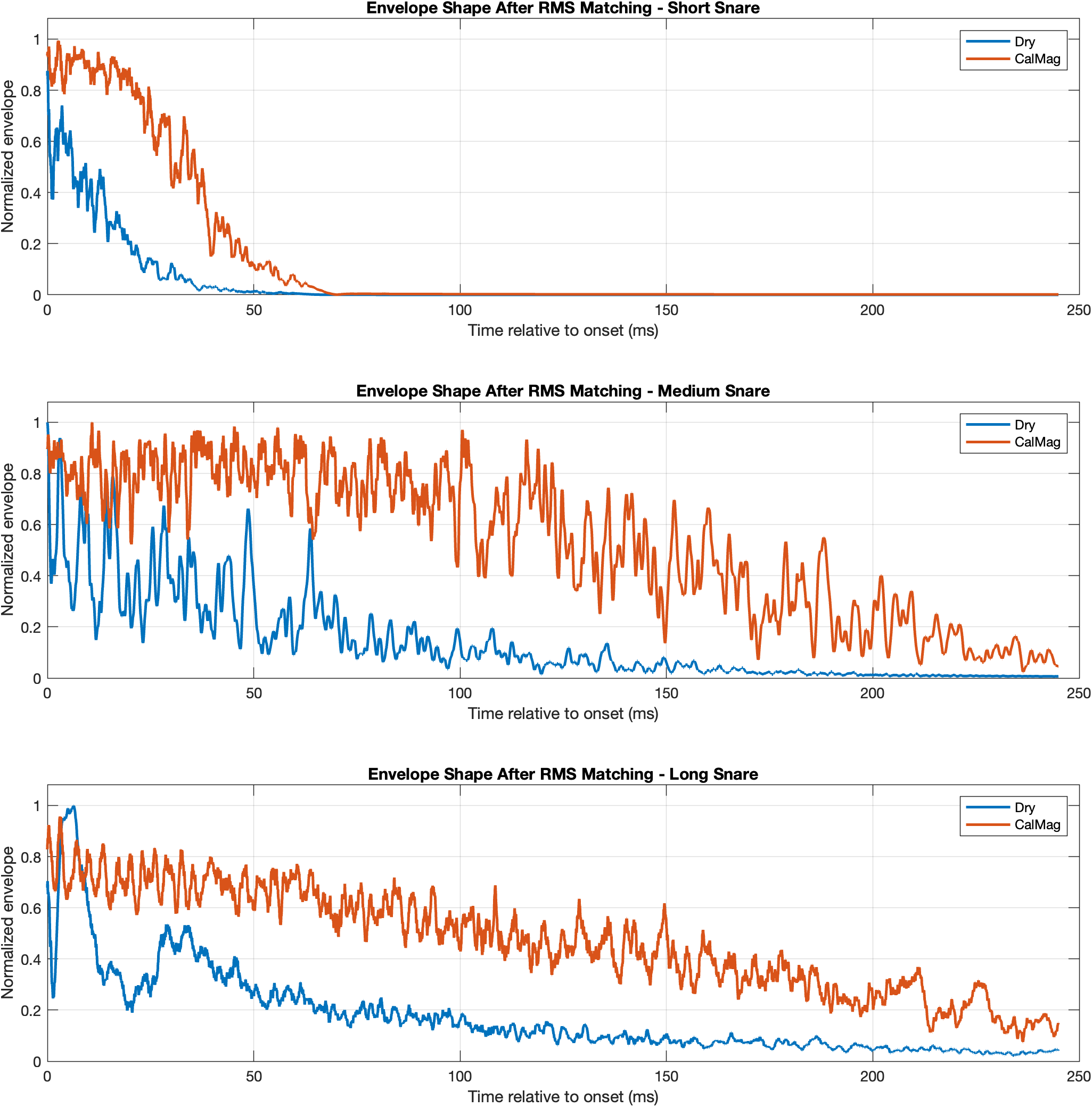
Across short, medium, and long transient material, CALMAG produced measurable envelope extension while preserving transient timing and onset position.
The observed behavior was not characterized by delayed attacks or the transient attenuation commonly associated with conventional compression.
Instead, the measurements indicate that signal activity persists for longer durations following excitation, increasing continuity between events while retaining transient definition.
#3 - Spectral Energy Redistribution
Spectral Consequence of Persistent State
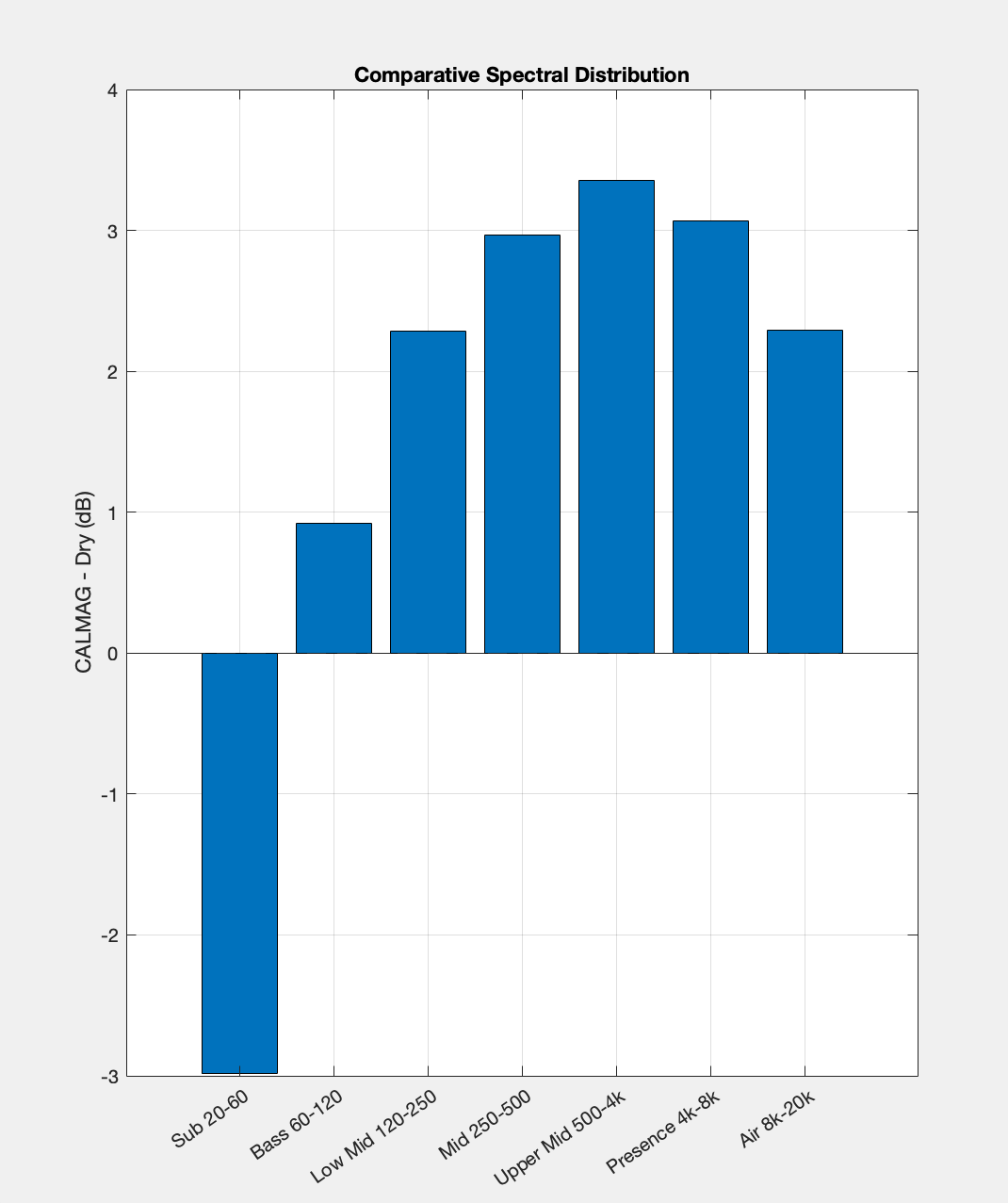
Relative to the dry reference, CALMAG redistributed spectral energy away from the lowest bass region and toward the low-mid, midrange, presence, and air frequency bands.
This redistribution occurred without detectable transient delay and without the transient attenuation typically associated with multiband compression.
The resulting distribution is consistent with a state-dependent process that alters spectral balance over time rather than a fixed linear frequency response.
Listening Example
The listening examples below use the same 60-second musical section used for the spectral redistribution measurement.
Source Material: Take A Daytrip – “Manzana” (Logic Pro Demo Project) Bars 65–105
The Dry and CALMAG versions were rendered from identical source material and LUFS matched prior to comparison. The CALMAG example uses the research configuration that produced the measurements shown above.
Dry Reference
CALMAG Research Configuration
Research Configuration
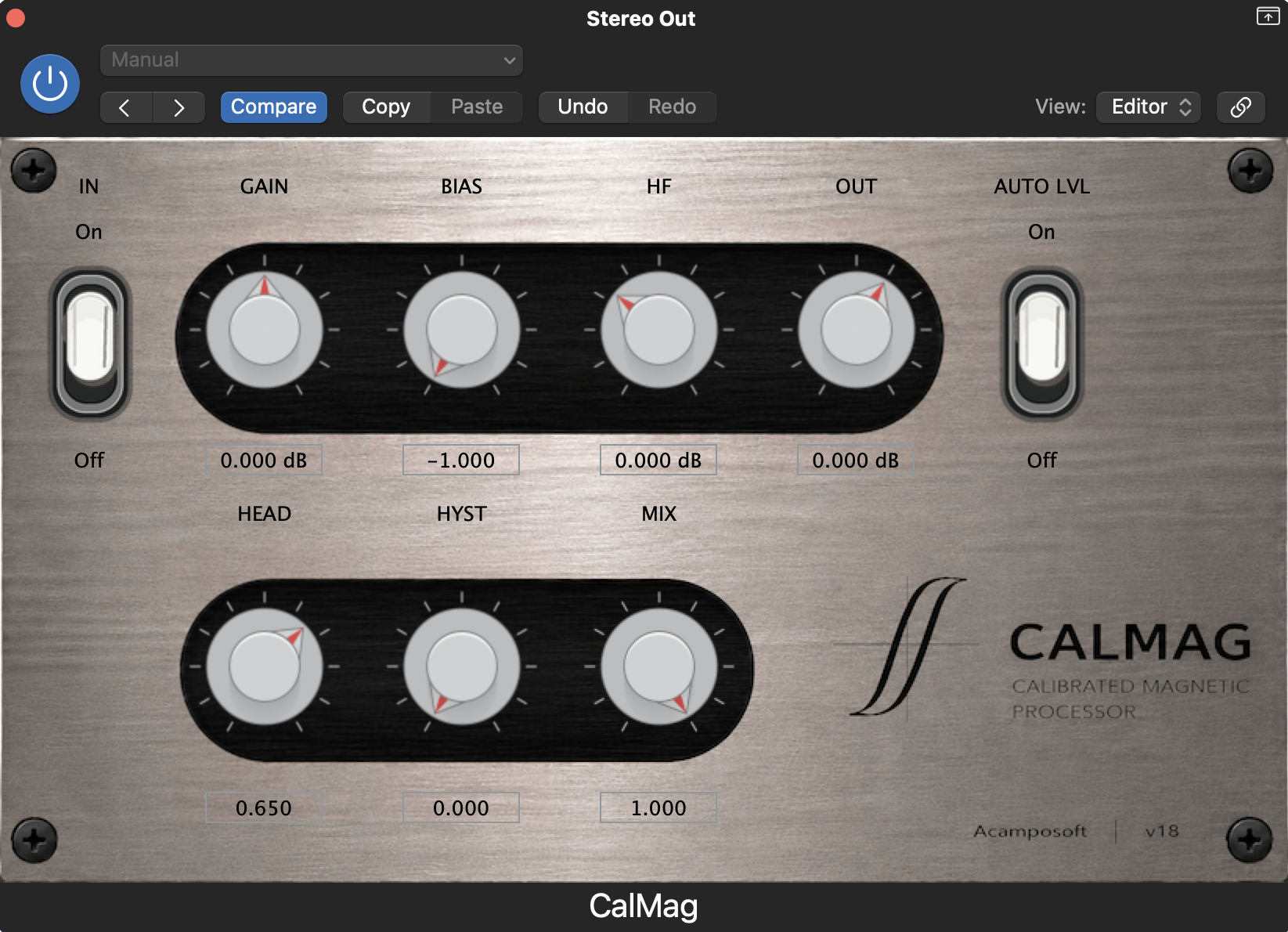
Gain 0.0 dB Bias -1.0 HF -0.414 dB Out 0.0 dB Head 0.5 Hyst 0.0 Mix 100% Auto Level On
No additional processing was applied after rendering, aside from loudness matching for comparison.
Continue The Investigation
Benchmark Library & Online Processor
The reference findings on this page preserve the original CALMAG research path. Broader benchmark examples and the online public beta processor live on dedicated pages.