01
Persistent state
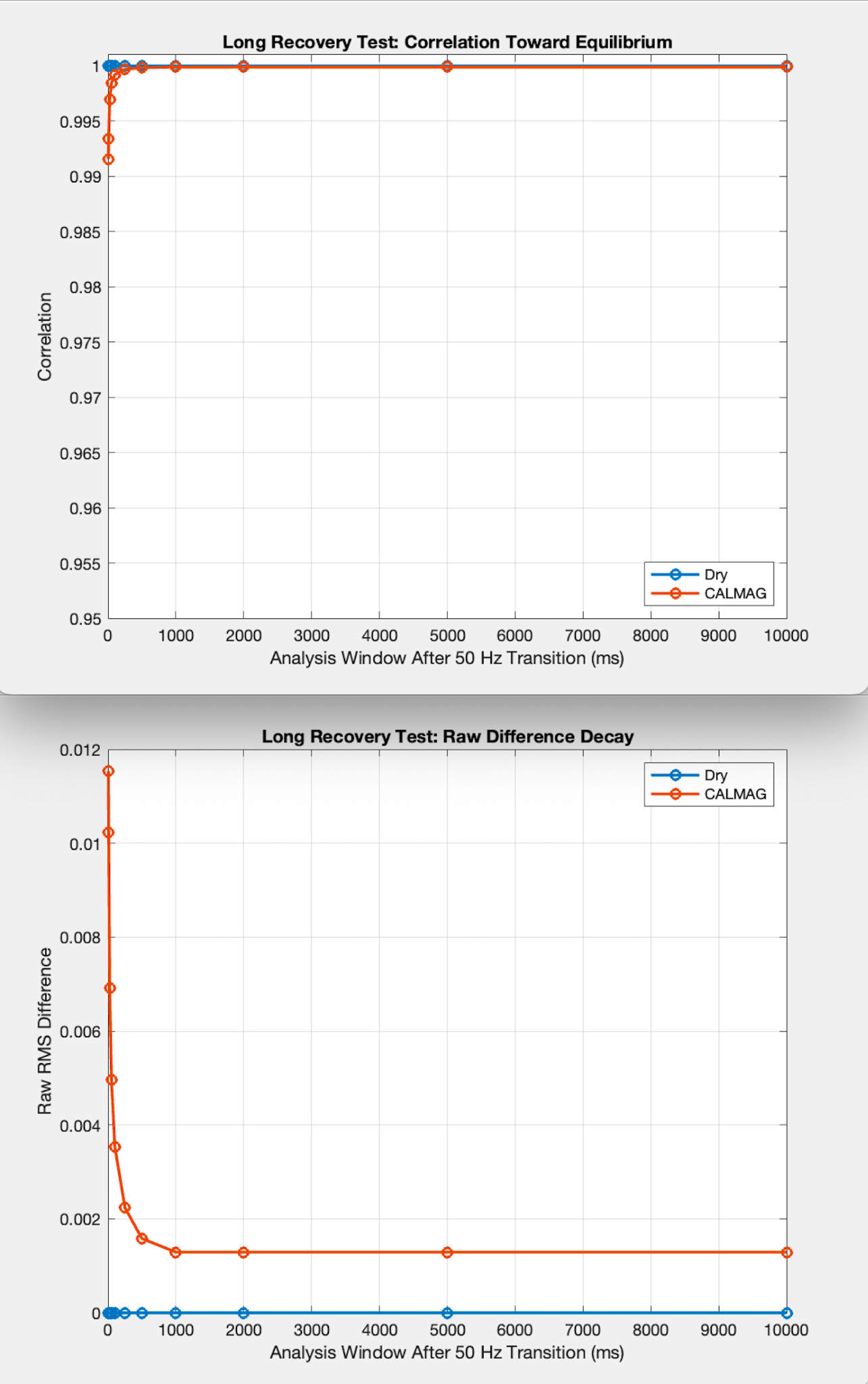
After the 50 Hz transition, CALMAG’s difference from the dry reference decays quickly, then settles into a small non-zero residual rather than immediately returning to exact identity.
CALMAG RESEARCH ARCHIVE
Calibrated Magnetic Processor
A MATLAB-based DSP investigation that progressed from a testable hypothesis through technical validation and into private beta preparation.
DEVELOPMENT PATH
RESEARCH THESIS
Conventional audio processors are commonly described through frequency response, distortion, compression ratio, attack and release behavior, THD, and IMD. Those measures are useful, but they do not fully explain perceived continuity effects often described as glue, cohesion, groove, flow, or timing lock.
CALMAG investigates whether inter-event continuity can be measured through temporal, amplitude, and spectral redistribution rather than described only through conventional dynamics or saturation language.
CALMAG is related to magnetic processing in the broad sense that operating state, calibration, level, and recovery behavior influence the result. It is not presented as a tape emulation.
TECHNICAL APPROACH
An interpretive framework for comparing how processor categories redistribute signal energy. It is not presented as a universal law.
| Processor | Temporal | Amplitude | Spectral |
|---|---|---|---|
| EQ | Low | Low | High |
| Compressor | Low | High | Low |
| Saturation | Low | Moderate | Moderate |
| Tape | Moderate | Moderate | Moderate |
| CALMAG | High | Moderate | Moderate |
The working hypothesis is that CALMAG is most clearly distinguished by temporal redistribution: how energy persists, recovers, and connects events over time while preserving recognizable transient landmarks.
KEY FINDINGS
These plots describe specific controlled tests. They support the stated observations but do not by themselves establish a universal model of all source material.
After the 50 Hz transition, CALMAG’s difference from the dry reference decays quickly, then settles into a small non-zero residual rather than immediately returning to exact identity.
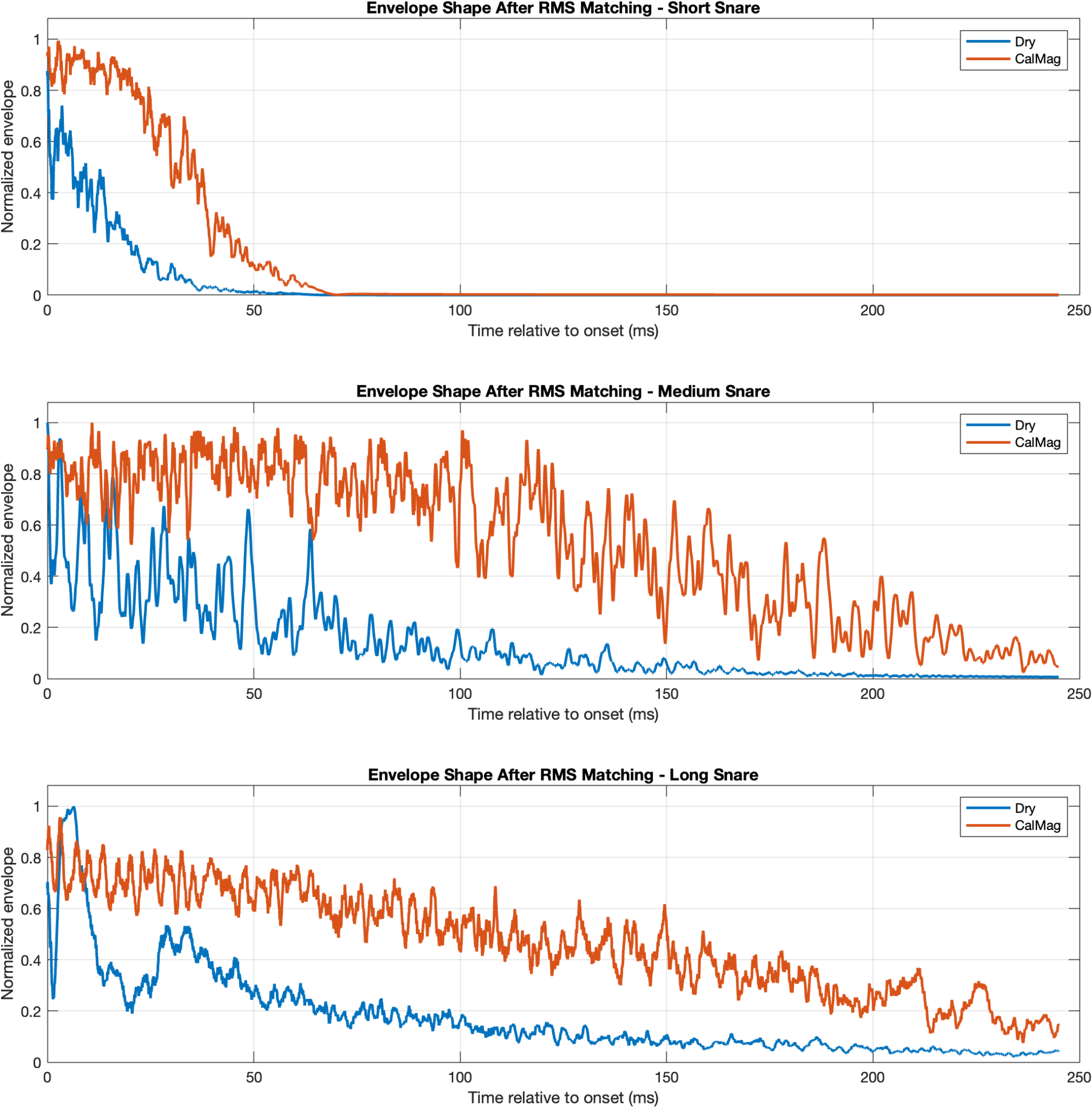
Across short, medium, and long snare examples, CALMAG maintains more envelope energy after onset than the RMS-matched dry reference while preserving the original event onset.
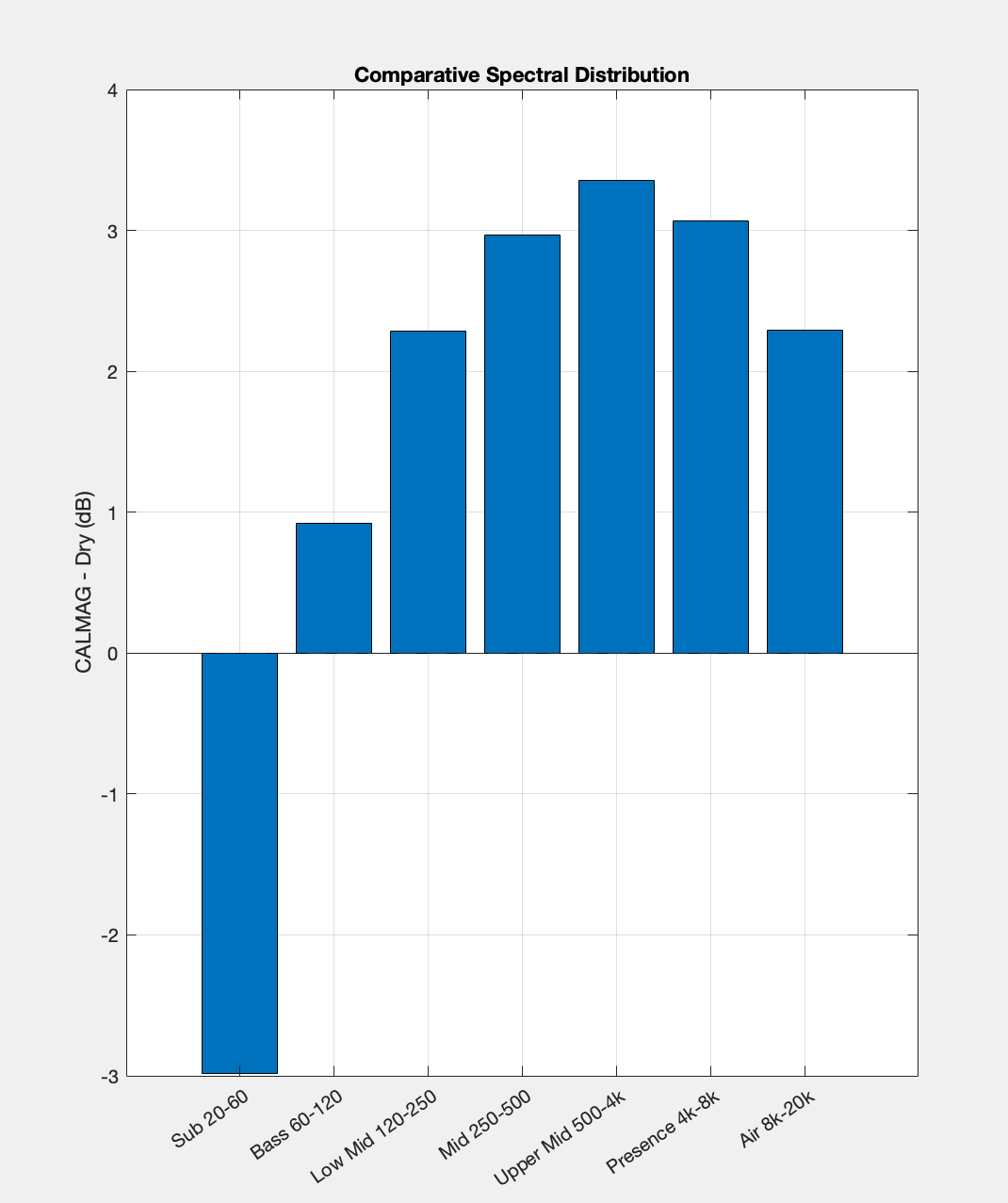
In this comparison, energy decreases in the sub-bass band and increases across bass, low-mid, midrange, presence, and air bands, with the largest measured increase in the 500 Hz–4 kHz region.
COMMERCIALIZATION
CALMAG has completed its initial research and technical validation. Current work is focused on preparing a private beta for evaluation in production audio workflows.
The commercial deployment path is now supported by the required MathWorks licensing, so no offline evaluation workflow is part of the current plan.
CALMAG PRIVATE BETA